

Your client resists something you can clearly see.
Perhaps they question your guidance.
Pull away from the deeper conversation.
Remain at the surface.
Or place the discomfort of the moment with you.
Because you care about their transformation, you give more.
Another explanation.
A clearer example.
An additional resource.
More time, preparation or access.
Yet the harder you work to reach them, the less received your work seems to become.
Client resistance in coaching can be deeply unsettling, especially when you are an experienced spiritual coach accustomed to seeing beneath the surface.
You know your work has depth.
Past clients have experienced meaningful transformation.
Years of healing, training and spiritual development have prepared you for difficult moments.
Still, this particular interaction leaves you questioning something you knew clearly before the pressure entered the room.
Why is your client not receiving what you see?
What else should you say?
How can you help them move through their resistance?
And why does their inability to receive your work feel so personal?
The visible problem appears to be the client’s resistance.
What may remain hidden is how your reaction to that resistance contributes to the disconnection you are trying to resolve.
What Client Resistance in Coaching Can Look Like
Resistance does not always appear as an obvious refusal.
Sometimes a client changes the subject whenever the conversation moves beneath the surface.
They may intellectualize an emotional experience, question your clarity or insist that the problem exists somewhere outside themselves.
Other forms of resistance are even more subtle.
A client may agree with everything you say but take no action afterward.
Another may repeatedly ask for answers while resisting the responsibility required to live them.
Occasionally, the discomfort of the coaching moment gets placed with you.
The client says you are not being clear.
They question whether the process is working.
Perhaps they imply that you have not given them enough.
At that moment, their protection may meet something still protected within you.
Instead of simply observing where your client is, you begin reacting to what their resistance appears to mean about you.
Why Giving More Does Not Always Resolve Client Resistance
When a client struggles to receive your work, providing more can feel like the natural solution.
A better explanation might create clarity.
An additional tool could help them understand.
More support may finally make the difference.
Sometimes a client genuinely does need clarification or another form of support.
Over-giving is not defined by the amount you provide; it is revealed by the pressure driving what you provide.
Are you freely offering something that serves the client?
Or does it feel increasingly important to make them understand, progress or recognize the value of your work?
That distinction matters.
Once giving becomes an attempt to overcome the client’s protection, you may begin taking responsibility for something that belongs to them.
The additional effort can also create more pressure within the coaching relationship.
Your client may feel pushed toward an insight they are not ready to meet.
Their resistance may intensify, causing you to work even harder.
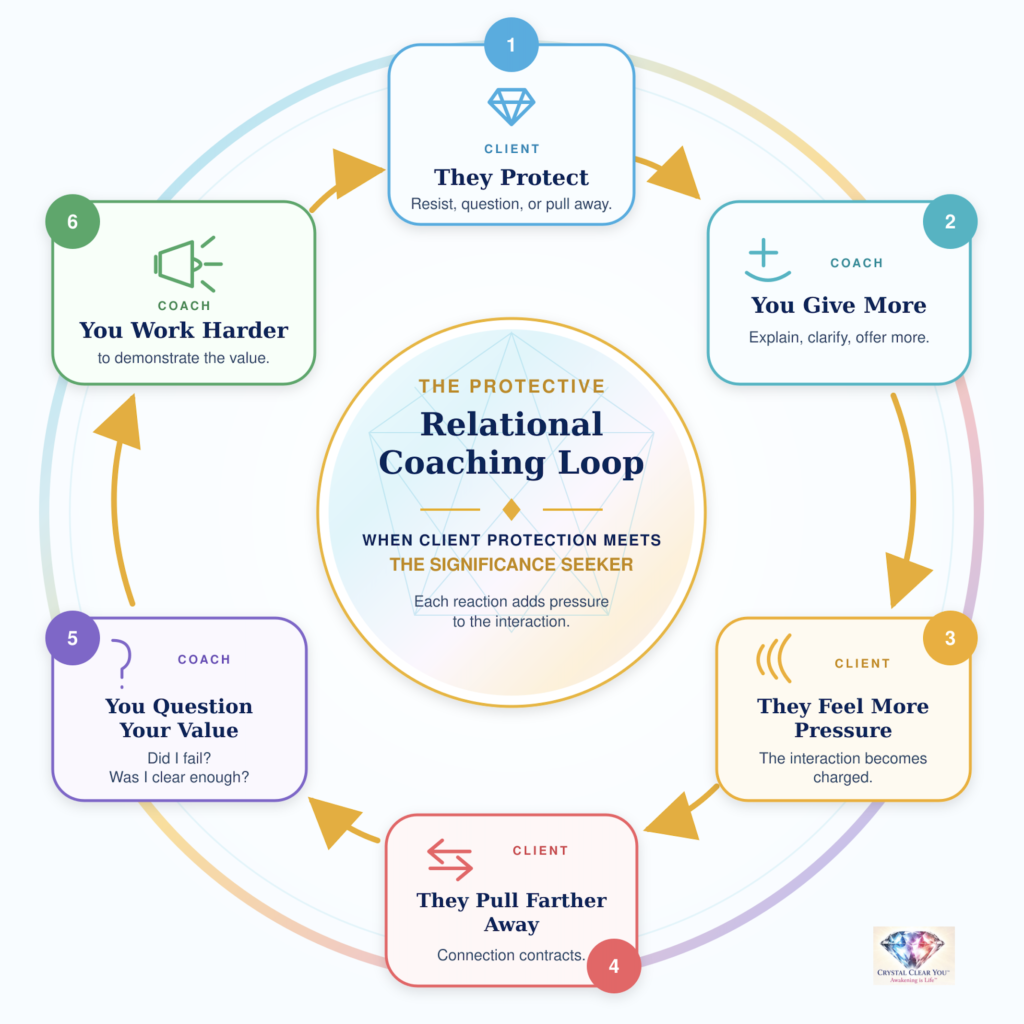
A protective relational loop begins to form:
The client resists.
You give more.
They pull farther away.
Then you question yourself and increase your effort again.
This cycle is one of the least recognized expressions of client resistance in coaching
because both people may believe they are working to move the relationship forward.
Neither person may consciously recognize what is happening.
Yet the very reaction intended to restore connection can deepen the disconnection.
The Pain Beneath “I Never Learned Anything From You”
This pattern shaped my coaching long before I could see it.
Years ago, a client wrote to me:
“I never learned anything from you.”
After everything I had given, her words went directly into the part of me that had spent a lifetime
trying to understand enough, achieve enough and give enough to finally be seen.
Her statement did not feel like one person’s perception of her experience.
It felt like a verdict on my value.
My instinct was not to question whether she had been willing or able to receive what I offered.
Instead, I examined everything I might have done differently.
More knowledge seemed necessary.
Greater preparation followed.
Giving even more appeared to be the answer.
At the time, I believed my devotion to clients was driving that effort.
Part of it was.
However, another part of me was trying to prove that I was valuable enough to be recognized.
That need remained hidden beneath qualities I genuinely valued in myself: generosity, responsibility, intelligence and care.
Because the protection looked so much like excellence, I did not recognize how it was participating in the problem.
Until I recognized my own participation in the interaction, I treated client resistance in coaching as a problem that greater effort should solve.
How Over-Giving Can Become Part of the Protective Relational Loop
My over-giving did not necessarily create the client’s original protection.
It did, however, keep me engaged in a dynamic where I became responsible for overcoming it.
Rather than allowing resistance to reveal where the client was, I experienced it as evidence that I had not yet given enough.
Their uncertainty became mine to resolve.
Their lack of recognition caused me to question my contribution.
Even their readiness to engage with the work began to feel like a reflection of my ability to lead.
This is one reason client resistance in coaching can affect experienced practitioners so deeply.
The client’s protection is only one part of the interaction.
Your own reaction may reveal where their inability to receive your work has become entangled with your need to be received.
Without that recognition, it is easy to work harder at creating an outcome the client must ultimately choose.
My Open Heart and the Pressure to Prove
In Human Design, I have what is called an open Heart.
One of the deepest pressures I have experienced through that openness is the drive to prove my value through what I understand, accomplish or provide.
Learning about my open Heart gave me language for the pattern.
Still, intellectual understanding did not automatically change my reaction when a client questioned my work.
I could know that my value was inherent and still feel compelled to demonstrate it.
Awareness of the mechanics did not prevent me from explaining more when my clarity was challenged.
Nor did spiritual insight automatically resolve the part of me that associated being received with being valuable.
For me, client resistance in coaching exposed the difference between knowing that my value was inherent and remaining connected to that value under pressure.
This is where information about a pattern and the embodiment of a deeper truth become two different things.
Understanding may help us recognize what is happening.
Pressure reveals whether we can remain connected to that understanding when it matters.
Recognizing the Significance Seeker
Within the 7 Axes of Self-Mastery, I call this pattern the Significance Seeker.
The Significance Seeker is not simply someone who wants attention, praise or importance.
Often, the pattern appears in highly capable and generous coaches who continually exceed expectations.
Knowledge becomes a source of safety because being exceptionally prepared feels less vulnerable than being questioned.
Extra time, access or support may be provided because fulfilling the original agreement somehow feels insufficient.
A client’s uncertainty can become a problem the coach believes she must solve.
Meanwhile, her own value becomes increasingly dependent upon whether the client recognizes, receives and transforms through what she provides.
From the outside, this may look like extraordinary service.
Underneath it, an unrecognized question may be driving the effort:
If my client does not receive the value of my work, does that mean I have failed to prove that I am valuable?
That is the hidden pressure of the Significance Seeker.
Through the lens of the Significance Seeker, client resistance in coaching may reveal where service has become entangled with the pressure to prove your value.
Protection Frequently Uses Our Authentic Gifts
Recognizing over-giving does not mean your generosity is false.
Protective patterns frequently recruit our genuine gifts.
Intelligence may become the way you establish credibility.
Through empathy, you may try to preserve connection.
Your depth can become a means of making yourself indispensable.
Devotion may become the evidence you use to confirm your significance.
The qualities themselves are not the problem.
Instead, the pressure surrounding them determines whether they are being expressed freely or recruited into protection.
This distinction is why simply telling yourself to give less may not resolve the pattern.
Stronger boundaries can be helpful.
Clear coaching agreements also matter.
However, the part of you that believes your value remains at risk will find other ways to prove itself until its needs are recognized.
That part does not need to be rejected, judged or destroyed.
It needs a different relationship with you.
What the Significance Seeker May Be Protecting
Beneath the Significance Seeker is an authentic capacity for Purposeful Impact that has never felt safe enough to stand on its own.
My own over-giving was not simply generosity, nor was it merely an ego pattern to transcend.
It was protection surrounding my capacity to create meaningful change.
For that protection to soften, I needed more than the intellectual knowledge that I had nothing to prove.
The part of me that worked so hard to establish my value needed to experience that I would not abandon myself when someone questioned my work.
Another person’s uncertainty could no longer define my clarity.
A client’s inability to receive what I offered could not become a verdict on my value.
Most importantly, I had to remain connected to myself without making their readiness my responsibility.
As that inner relationship changed, my deeper authority had more room to emerge.
Giving could come from what was genuinely mine to offer rather than from the pressure to establish my worth.
Meeting Client Resistance Without Abandoning Yourself
Years after receiving that painful message, another client told me:
“You’re not being clear.”
The same pressure entered the room.
This time, however, I could recognize it.
Her words were expressing her experience of uncertainty. They were not the truth about me.
Acknowledging her experience did not require me to absorb it.
Remaining connected did not mean accepting responsibility for creating certainty she did not yet possess.
Likewise, honoring my clarity did not require me to make her wrong.
I could stay in relationship with her without abandoning myself.
That moment represented an entirely different way of meeting client resistance in coaching.
Rather than explaining myself into being received, I could become curious about what the interaction was revealing.
What belonged to her?
Which reaction belonged to me?
What was happening between us?
And what would allow me to remain present without forcing, proving or withdrawing?
Working skillfully with client resistance in coaching begins with recognizing what is happening before deciding why it is happening.
Recognition Must Come Before Explanation
It is tempting to immediately decide why a client is resisting.
Perhaps they are afraid.
Maybe they are projecting.
Their identity could be protecting itself from change.
Any of those explanations might be accurate, but assuming the cause can move you away from what is actually happening.
Precise recognition comes first.
Notice the observable client behavior.
Acknowledge your internal reaction.
Discern what belongs to each person.
Then explore the interaction without using a conclusion to escape its uncertainty.
The same care applies to your own pattern.
Not every generous action is over-giving. Likewise, not every instance of over-giving comes from the Significance Seeker.
The purpose of recognition is not to force an experience into an archetype.
Instead, recognition provides a doorway through which the unique meaning of the moment can emerge.
From Proving Your Value to Purposeful Impact
The transformation of the Significance Seeker is not a journey from insignificance to significance.
Your value was never missing.
Rather, the movement takes you from seeking evidence of your value through what you achieve or provide to accepting the value that is already inherent within you.
From that acceptance, different questions become possible:
What is genuinely mine to offer in this moment?
Which part of this interaction belongs to the client?
Am I giving from freedom or reacting to pressure?
What am I afraid their resistance will mean about me?
What might happen if I stop trying to make my value visible?
Which authentic capacity has this protection been guarding?
These questions do not make generosity suspect.
They restore your freedom to choose it.
Deep care for your clients can remain.
Extraordinary insight may still be offered.
A client’s experience can be acknowledged with humility and openness.
Their readiness, resistance or recognition, however, no longer needs to determine your value.
The energy once consumed by proving your significance then becomes available for Purposeful Impact.
How Client Resistance in Coaching Becomes a Doorway Into Awakening
Much of spiritual awakening teaches us how to ascend.
We witness the ego.
Disidentify from pain.
Return to presence.
Reconnect with Source.
Those movements matter.
Yet ascension alone does not reveal whether we can remain connected to what we know when our authority is questioned.
Descension asks consciousness to enter the body, the business, the relationship and the coaching room.
Can you remember your value while a client resists your work?
Will you remain connected without taking responsibility for how your depth is received?
Is it possible to recognize your reaction without mistaking it for your identity?
Can protection be met without allowing it to lead?
This is where expanded consciousness becomes embodied leadership.
Seen clearly, client resistance in coaching is not merely an obstacle to overcome.
It can become the pressure through which both the client’s protection and your own become visible.
The next time client resistance leaves you explaining more, giving more or questioning your value, resist the urge to immediately correct the behavior.
Begin with recognition.
Your client’s protection may have met something still protected within you.
That does not mean you have failed to heal.
It may mean the pressure has revealed an authentic capacity that is ready to emerge.
The reaction is not your identity.
But it may be guarding the part of you that came here to create Purposeful Impact.
🔷 If a difficult coaching moment is staying with you, begin with The Coach’s Field Guide™.
Seven archetypes. Seven Axes. Seven doorways into deeper recognition.
Recognize what the moment is revealing.
Because recognition is not the resolution.
It is the doorway to everything that becomes possible next.
Awakening is Life™
Love and Brilliance,