

Your client criticizes something foundational to your work.
Before you consciously understand what happened, you begin monitoring the relationship.
You soften your language.
Offer another explanation.
Search for the words that might make your client feel more comfortable.
Perhaps you move past the tension before either of you understands what just entered the room.
Client criticism in coaching can feel like a professional issue that needs to be resolved quickly. Yet the intensity of your reaction may be revealing something deeper than a disagreement about your work.
What if your client’s criticism has triggered a part of you that learned long ago that disagreement was unsafe?
When Client Criticism Entered My Coaching Room
The moment felt like a shock.
“I don’t like these books,” my client said during a group mastermind.
When I asked why, she replied:
“I don’t agree that our thoughts create our reality.”
She was questioning a foundational principle within the traditional Law of Attraction books I was teaching.
Her disagreement was allowed.
Clients are permitted to question what they are learning. Coaches also need to remain receptive to genuine feedback.
Nevertheless, my body received the interaction as something more than an intellectual difference of opinion.
Pressure entered the room.
Part of me wanted to soften what I knew, avoid a direct confrontation and restore harmony within the group.
Rather than exploring what the disagreement was bringing forward, I found a way to continue the session.
Only afterward did I recognize how strongly the interaction had affected me.
Client criticism in coaching had met a place within me that felt unseen, unheard and misunderstood.
Why Experienced Coaches Can Still Feel Triggered
Years of spiritual awareness do not prevent every nervous-system reaction.
You may understand projection.
Recognize resistance.
Know how to witness your thoughts.
Return to presence.
Connect with Source.
Even so, a client’s criticism can still trigger something before your conscious awareness catches up.
The reaction does not mean your spiritual work has failed.
Nor does it automatically mean the client is wrong.
Instead, the intensity may provide a coordinate—a precise place to look for something within you that has remained protected.
Perhaps criticism once felt dangerous because an authentic aspect of you was experienced as:
- too powerful
- too emotional
- too perceptive
- too expressive
- too different
- too desirous
- or simply “too much”
Without the safety or language to understand that aspect of your identity, you may have learned to protect it.
You softened your truth.
Monitored other people’s reactions.
Avoided necessary conflict.
Gave more than the moment required.
Changed yourself to preserve harmony.
Eventually, those protective responses became so familiar that they appeared to be part of your personality.
People-Pleasing May Be Protecting More Than You Realize
People-pleasing is often treated as an unwanted behavior that should be eliminated.
That interpretation misses its deeper intelligence.
A protective response may have formed because some aspect of your authentic nature did not yet feel safe enough to enter relationship.
Distance from conflict gave that hidden aspect time to survive.
Silence kept it from being criticized.
Over-giving helped you remain connected to the people upon whom you depended.
Softening your truth reduced the possibility of rejection.
These strategies may have been necessary before you possessed the relational capacity to remain connected to yourself during disagreement.
However, protection can continue operating after its original purpose has been served.
The same people-pleasing that once kept you safe may later interfere with your ability to remain clear, honest and present with a client.
That is why client criticism in coaching can become such an important doorway.
The criticism does not create the hidden wound.
It reveals where protection may still be operating around it.
The People Pleaser and the Relationship Axis
Within the Relationship Axis of The Complete Awakening System™, I call this protective archetype The People Pleaser.
Its surface expressions may include:
- monitoring the client’s reaction
- softening a difficult recognition
- avoiding necessary conflict
- explaining until the client appears settled
- changing a boundary to prevent disappointment
- assuming responsibility for the client’s emotions
- carrying the session long after it ends
Beneath these behaviors is an unconscious need to be liked and a fear of criticism or disconnection.
The need itself is not shameful.
It points toward a part of you that learned to preserve relationship by leaving something important within yourself behind.
Therefore, the answer is not to become less caring.
Neither is it to ignore your client’s response or hold rigidly to your position.
The deeper invitation is to develop enough relational capacity to hear the client without abandoning yourself.
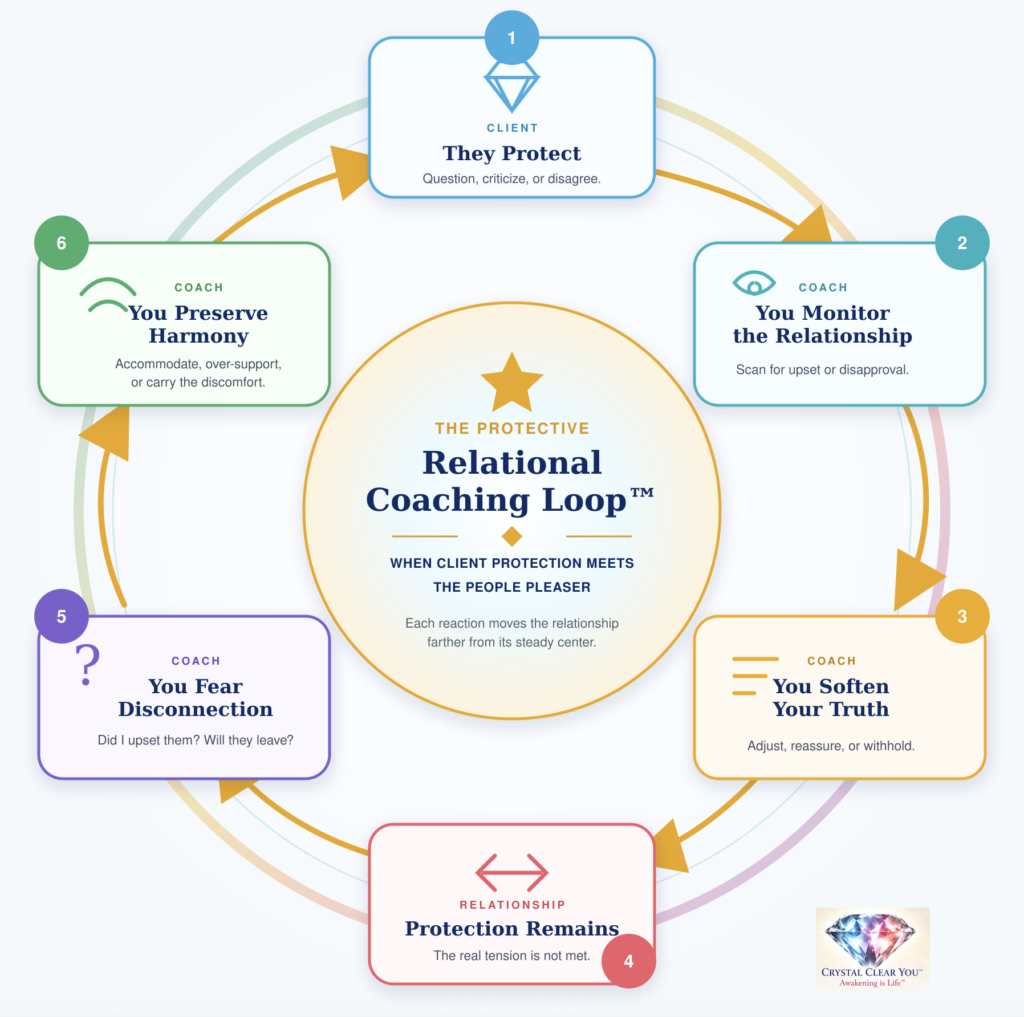
The Protective Relational Coaching Loop™
Client criticism in coaching can initiate a predictable relational cycle.
The client protects.
They question, criticize or disagree.
You monitor the relationship.
Your attention moves toward signs of upset, withdrawal or disapproval.
You soften your truth.
You adjust, reassure, over-explain or withhold what you recognize.
The protection remains.
Because the real tension is not met, neither person encounters what may be happening beneath the disagreement.
You fear disconnection.
Questions arise: “Did I upset them? Will they leave? Am I still the right coach?”
You preserve harmony.
More support, reassurance or emotional responsibility enters the relationship.
This is The Protective Relational Coaching Loop™.
Neither person may consciously understand why the interaction has become more difficult.
The client may believe they are responding only to the coaching.
Meanwhile, the coach may believe she is simply trying to help.
Underneath the visible conversation, one person’s protection has met something still protected within the other.
Harmony Is Not the Same as Relationship
A harmonious coaching relationship may appear successful from the outside.
No one becomes visibly upset.
Difficult subjects are handled gently.
Sessions end on a positive note.
Yet the absence of conflict does not necessarily indicate the presence of genuine relationship.
Sometimes harmony is maintained because the coach does not feel safe allowing discomfort to remain.
A strong coaching relationship is not one in which tension never appears.
It is one in which the coach can remain present without making the client’s comfort the condition of her own safety.
That distinction changes how the coach approaches client criticism.
Instead of immediately trying to resolve the discomfort, she can become curious about it.
What is the client communicating?
Does their criticism contain valuable feedback?
What is happening within the client?
Which reaction is occurring within the coach?
What truth belongs to each person?
Such questions create room for responsibility without blame.
Responsibility Without Blaming Yourself
Taking responsibility for your reaction does not mean assuming responsibility for the entire interaction.
The client remains responsible for their behavior.
The coach remains responsible for relating to her own reaction.
This distinction does not require you to:
- tolerate harmful behavior
- assume the client is projecting
- reject useful criticism
- blame yourself for being triggered
- pretend that the external interaction does not matter
- remain in a coaching relationship that is no longer aligned
Instead, responsibility asks you to meet your internal experience without turning it into evidence that you are wrong, unsafe or unqualified.
From that steadier position, you can evaluate what is happening more clearly.
You may acknowledge valid feedback.
Maintain a necessary boundary.
Ask an honest question.
Allow uncertainty to remain.
Offer your recognition without imposing it.
Conclude that the coaching relationship is no longer appropriate.
Your response arises from discernment rather than the automatic need to preserve harmony.
What the Coach Can—and Cannot—Provide
An experienced coach can help create a relational container in which deeper recognition becomes possible.
She can remain neutral and present.
Hold an honest question.
Invite the client to feel.
Allow uncertainty.
Maintain ethical boundaries.
Offer recognition without forcing agreement.
However, the coach cannot create the client’s inner relationship for them.
She cannot make a hidden aspect feel safe.
Manufacture readiness.
Complete the client’s awakening.
Or provide certainty that must ultimately arise from within the client.
When we forget these limits, service can become rescue.
Care can become emotional responsibility.
Support can become self-abandonment.
Recognizing those boundaries does not diminish the coaching relationship. It creates the conditions for a more honest one.
The Relational Capacity to Remain
Moving beyond people-pleasing requires more than deciding to stop accommodating other people.
The deeper work involves developing the capacity to remain in relationship with yourself while another person is having their own experience.
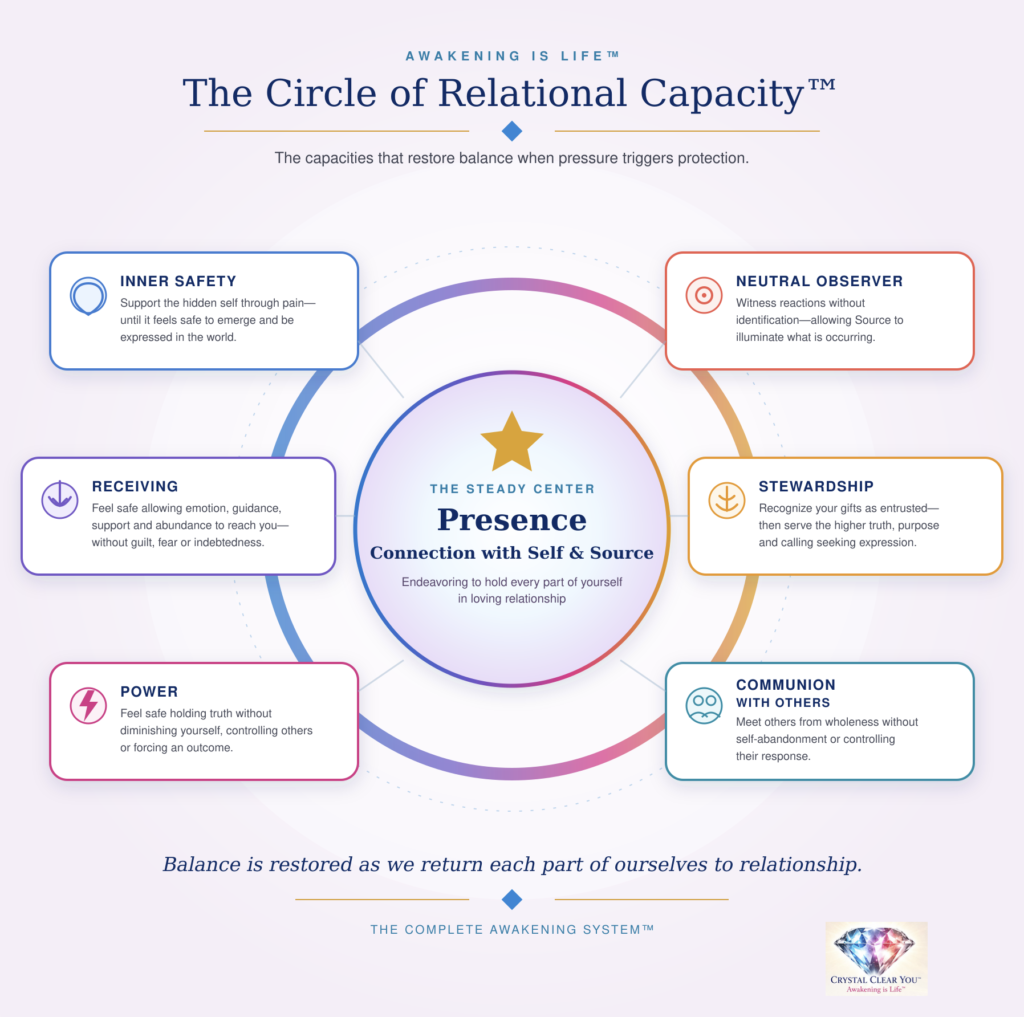
I describe this through The Circle of Relational Capacity™:
Inner Safety supports the hidden aspect through its pain until it feels safe to emerge and be expressed.
Receiving allows emotion, guidance, support, opportunity and abundance to reach you without guilt, fear or indebtedness.
Power enables you to hold your truth without diminishing yourself, controlling another person or forcing an outcome.
Neutral Observation helps you witness a reaction without becoming completely identified with it.
Stewardship places your gifts in service to the higher truth and purpose seeking expression through you.
Communion with Others allows you to enter relationship from wholeness without making another person’s response your responsibility.
At the center is Presence: Connection with Self and Source.
Presence is the capacity to hold every part of yourself in loving relationship while remaining available to what the moment is revealing.
Awakening Does Not Require Perfect Balance
Relational capacity does not mean you will never react again.
Awakening is not a permanent state in which criticism no longer affects you.
Instead, awakening allows you to recognize when something within you has fallen out of relationship with the whole.
The reaction becomes a coordinate rather than evidence of failure.
You begin noticing which capacity became difficult to access.
Did you lose your inner safety?
Stop receiving what the moment was communicating?
Diminish your power?
Become identified with the reaction?
Forget the truth you were stewarding?
Leave communion and begin managing the other person?
Recognition gives you somewhere to begin.
From there, you can return to relationship with the part of yourself that needs your attention.
What Client Criticism May Be Revealing
In my interaction with the mastermind client, I did not need to abandon my truth.
Neither did I need to force her to accept it.
She was entitled to her beliefs.
I was responsible for remaining in relationship with my own.
Yet the intensity of my response revealed that the disagreement had encountered something deeper within me.
A hidden part felt unseen, unheard and misunderstood.
My instinct to preserve harmony had kept that aspect outside my conscious relationship for years.
The client did not create that wound.
Her criticism brought me to the place where I could begin to recognize it.
That was the real opportunity within the moment.
Questions to Consider After Client Criticism
When client criticism in coaching stays with you, ask:
- What happened inside me when my client became uncomfortable?
- What did I begin doing to manage their reaction?
- What did their criticism appear to threaten?
- Did I soften something I knew?
- Which hidden aspect of me may be surfacing?
- Which relational capacity became difficult to access first?
- Can I remain with myself while honestly considering what the client communicated?
- What would internal alignment ask of me now?
You do not need to resolve every answer immediately.
Recognition is the first movement.
Client criticism may not mean you are failing as a coach.
It may be revealing the precise place where your relational capacity is ready to deepen.
The question is not simply whether your client agrees with you.
The deeper question is whether you can remain connected to yourself, receptive to the truth of the moment and available to the person in front of you—without leaving yourself behind.
Begin With The Coach’s Field Guide™
The People Pleaser is one of seven protective archetypes within the 7 Axes of Self-Mastery™.
The Coach’s Field Guide™ helps you recognize the surface pattern, unconscious need, client mirror and hidden gift that may be emerging when your depth is not received.
Seven archetypes. Seven Axes. Seven doorways into deeper recognition.
Explore The Coach’s Field Guide™
Because recognition is not the resolution.
It is the doorway to everything that becomes possible next.
Awakening is Life™
Love and Brilliance,

Crystal A. Davis
Awakening Engineer
Creator of The Complete Awakening System™ and The Coach’s Field Guide™
Awakening is Life™